


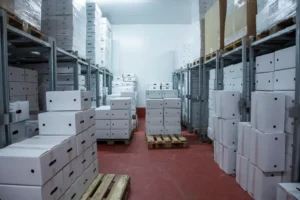
Keeping a commercial freezer running in the Oklahoma heat is a job all on its own. When you’re running a restaurant, a floral shop, or even a convenience store in Mustang, that giant metal box is the vault where you keep your revenue frozen until it’s ready to be sold.
And when it breaks, you lose money on the repair and you lose money on the spoiled inventory. That double hit is exactly what we want to help you dodge.
We see it happen too often: a compressor gives out on a Friday night or a seal fails right before a holiday weekend. Suddenly, you’re scrambling to move thousands of dollars of steak or ice cream before it turns into a lukewarm puddle.
The good news is that most of these catastrophic failures aren’t random bad luck. They’re usually the result of small, ignored issues that snowball into expensive disasters. You can prevent the majority of breakdowns just by changing how you look at maintenance, and when you can’t, we’re here to help with the best commercial freezer repair in Mustang.
Keep Those Coils Clean
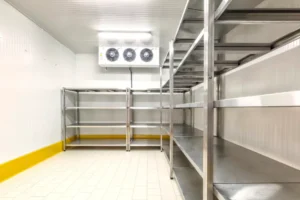
Your freezer breathes through its condenser coils. When they get clogged up with grease, dust, or flour, the unit has to work twice as hard to maintain the same temperature. It’s like trying to run a marathon while breathing through a straw. Eventually, the heart (or in this case, the compressor) is going to give out.
In a commercial kitchen, the air is thick with grease and particulate matter, which acts like a magnet for dust on your coils. If you ignore this for six months, you’ll notice your energy bills creeping up. If you ignore it for a year, you’re looking at a burnt-out compressor.
Grab a stiff bristle brush and a vacuum. You should be cleaning these coils at least once a month. If you’re in a bakery where flour is always in the air, or a place that fries a lot of food, you might need to do it every two weeks. It takes fifteen minutes of elbow grease, which is a lot cheaper than the alternative.
Check Your Gaskets Regularly
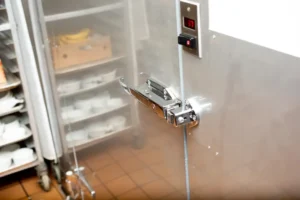
The rubber seal around your freezer door is the only thing standing between your frozen goods and the warm Mustang air. We call this the gasket. When it rips or gets brittle, cold air leaks out constantly. Your freezer notices the temperature drop and kicks the compressor into overdrive to compensate.
You can test this easily. Grab a dollar bill and close the freezer door on it. If you can pull that dollar out without any resistance, your seal is shot. Do this test on all sides of the door.
Gaskets get nasty. Sauces spill, sticky hands grab the door, and mold can grow in the folds. You need to wipe these down with mild soapy water weekly. Harsh chemicals like bleach can actually dry out the rubber and make it crack faster, so stick to dish soap. Replacing a gasket is one of the cheapest repairs you can make, but ignoring a bad one is one of the most expensive mistakes.
Don’t Block the Airflow
We know space is tight. You’re trying to fit three weeks of inventory into a space meant for two. But when you stack boxes all the way to the ceiling or cram them right up against the internal fans, you choke the system.
Cold air needs to circulate to do its job. If the air can’t move, you get warm spots. The thermostat might be reading a nice chilly temperature near the sensor, but that box of chicken breasts in the corner could be thawing out.
Make sure there’s at least a few inches of clearance around the fans and vents inside the unit. Also, look at the outside of the unit. If you’ve shoved the freezer tight against the back wall, the heat it’s trying to expel has nowhere to go. It just recycles that hot air, making the compressor run hotter and hotter. Pull it out from the wall a few inches to let the heat dissipate.
Monitor the Temperature Manually
Digital displays on commercial freezers can lie. Sensors fail or get calibrated incorrectly. So, you might walk by and see “-5 degrees” on the display and think everything is perfect, meanwhile, the actual temperature inside is creeping up to 20 degrees.
Buy a couple of inexpensive analog thermometers and place them in different parts of the freezer. Check them every morning when you open up. If you see a discrepancy between your manual thermometer and the digital display, you know something is wrong before the food starts to spoil.
Listen to Your Machine
You know the sounds your kitchen makes, the hum of the dishwasher and the whir of the mixer. You should also know the sound of your freezer.
A healthy freezer has a steady, rhythmic hum. If you start hearing clicking, grinding, or squealing, the machine is screaming for help. A clicking sound often means the starter relay is struggling to kick the compressor on, while asqueal could be a fan belt or a bearing going bad.
Don’t tune these noises out. As soon as the sound changes, investigate. It’s tempting to ignore a weird noise if the freezer’s still cold, but that noise is the sound of a part wearing itself down to the point of failure.
Manage the Ice Buildup
Automatic defrost cycles are great, but they aren’t magic. Sometimes, especially in humid Oklahoma summers, ice can build up on the evaporator coils faster than the defrost cycle can melt it. When ice covers the coils, they can’t absorb heat.
If you see ice creeping up the walls of the interior or coating the fans, you have an issue. It could be a drain line clog causing water to back up and freeze, or it could be a defrost timer failure.
As a side tip, never take an ice pick to the inside of your freezer. We’ve seen too many business owners accidentally puncture a refrigerant line while trying to chip away ice. That turns a nuisance into a catastrophic failure instantly. If you have heavy ice buildup, you need to manually defrost the unit safely or call in a pro to see why the auto-defrost isn’t keeping up.
Keep the Drain Line Clear
Your freezer creates water, and during the defrost cycle, ice melts and drains away through a tube. If that tube gets clogged with slime or food debris, the water has nowhere to go. It backs up into the freezer and turns into a sheet of ice on the floor of the unit.
This is a safety hazard for your staff, but it also increases the humidity inside the freezer, which makes the compressor work harder. Pour a mixture of warm water and vinegar down the drain line once a year to keep it flowing freely. This prevents algae buildup and keeps that nasty drain smell away.
Knowing When to Call for Commercial Freezer Repair
There’s a line between DIY maintenance and needing professional help, and it’s one you don’t want to cross. Cleaning coils and gaskets is your job. Messing with electrical components or refrigerant lines is not.
If you notice the compressor is running non-stop without cycling off, that’s a red flag. If the outer walls of the freezer are hot to the touch, that’s another one. And obviously, if the temperature is fluctuating wildly despite your best efforts, it is time to make the call.
Trying to fix complex refrigeration issues yourself often voids warranties and leads to bigger problems. Investing in commercial freezer repair before the unit dies completely is the smartest financial move you can make, since the cost of a service call is nothing compared to the cost of a new compressor or worse, a lawsuit from serving spoiled food.
Don’t Let a Breakdown Freeze Your Business
Your freezer is the backbone of your operation. Treat it with a little respect, keep it clean, and pay attention to what it’s telling you.
If you’ve checked the coils, wiped the gaskets, and your unit is still acting up, don’t wait for the total failure. It’s time to bring in the experts who know these machines inside and out.
Contact Mustang Appliance Repair today and let us keep your cold storage running smoothly so you can focus on running your business.